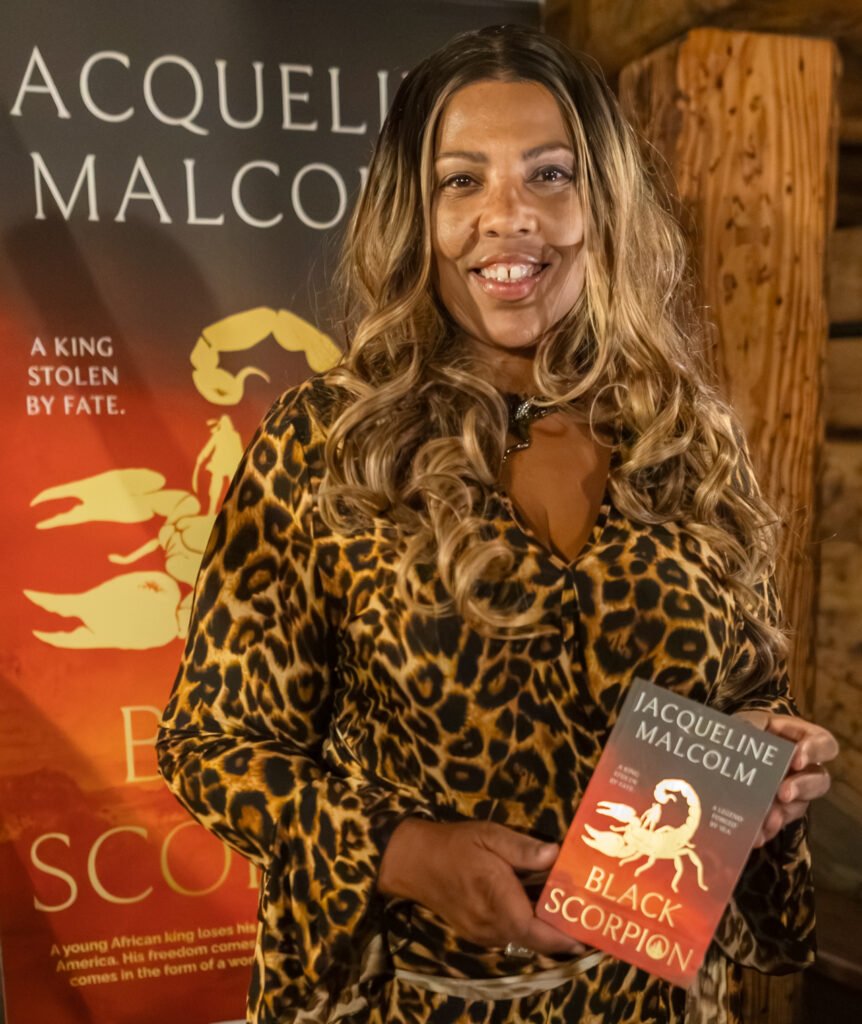
A King Who Forgot His Crown: Jacqueline Malcolm’s Black Scorpion Unveils a Powerful Journey of Identity and Self-Discovery.
Jacqueline Malcolm, a PhD student at Brunel University with an MA in theatre studies, appeared on the International Book Show to discuss her debut novel, Black Scorpion, a historical fiction work blending fantasy elements with profound themes about identity and self-discovery.
Malcolm is a playwright and director whose professional focus centres on actor wellbeing and protection. Beyond her academic and creative pursuits, she hosts a podcast called It’s Dr. Actually on the Colourful Radio/Colourful TV platform, dedicated to giving people with doctorates and PhDs a platform to demystify what it means to hold advanced degrees. She resides in Norfolk and describes herself as a daughter, sister, and aunt who deeply values family connections.
an extraordinary protagonist whose life unfolds across multiple distinct chapters. The narrative begins when a young prince ascends to his birthright as king following his father’s death, establishing himself as a great leader. However, a mysterious event transpires that causes him to lose his memory entirely, leaving him with no recollection of his identity, origins, or family.
When the protagonist awakens aboard a slave ship bound for America, he accepts his circumstances as slavery, having no memory to contradict this imposed reality. His fate takes another dramatic turn when pirates overtake the vessel, and he becomes the greatest pirate to sail the seven seas. Throughout his pirate years, he demonstrates remarkable skills in strategy, warfare, and language—abilities he cannot explain because he cannot remember who he truly is or where such knowledge originated.
The turning point arrives when his memory unexpectedly returns, revealing that he was never meant to be a slave or pirate, but rather a king with a kingdom, queen, and son awaiting his return. Facing enemies determined to prevent his homecoming, he embarks on an epic journey filled with gods, spirit animals, mermaids, love, hatred, and war.
Malcolm emphasizes that Black Scorpion is fundamentally about identity rather than fantasy elements like mermaids. She argues that contemporary society faces a widespread identity crisis, with constantly shifting goalposts making it difficult for people to establish their sense of self. The novel’s central message is that when individuals don’t know who they are, they will accept whatever labels society assigns them—and often become exemplary versions of those false identities.
Malcolm asserts that authentic brilliance emerges only when people understand their true identity, values, beliefs, and purpose. Without this self-knowledge, individuals cannot fulfil their genuine potential or become their authentic selves. The protagonist’s journey, therefore, serves as a metaphor for humanity’s universal need to discover authentic identity before achieving true fulfilment and greatness.
Black Scorpion is widely available through major retailers including Waterstones, Foyles, World of Books, and Amazon, with both paperback and Kindle editions accessible to readers. Those interested can visit Malcolm’s website at jacquelinemalcolm.co.uk for additional information, and she encourages readers to share their reviews and thoughts on the novel.
