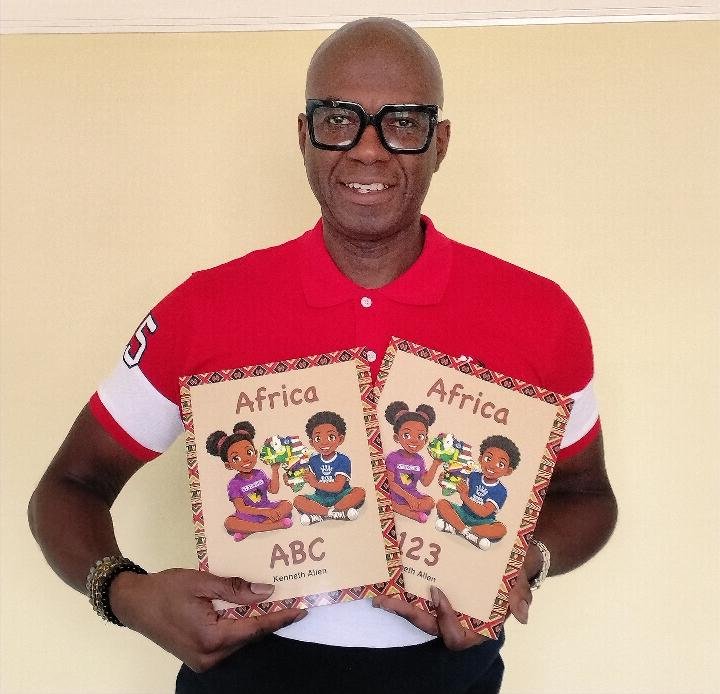
Author Kenneth Allen joined the International Book Show to discuss his children’s books, Africa ABC and Africa 123, and the personal journey that inspired them.
Allen was born in London to parents from the Caribbean island of Montserrat and grew up in Hackney and Islington in a loving but materially modest home, where he and his siblings learned to share the few toys they had. Growing up in the 1970s, he recalls seeing little imagery of Black people on television, and much of what appeared was not positive. He drew inspiration instead from music, sports, education and history, citing figures like Muhammad Ali and Bob Marley, before spending more than 20 years in the national newspaper industry and working his way up to a supervisor managing a team of five.
As a child, almost everything he learned about Africa concerned enslavement, poverty or conflict. In his twenties, a thirst for knowledge led him to read widely, and he describes Chancellor Williams’ Destruction of Black Civilization as the catalyst for self-knowledge. Discovering Africa’s rich history empowered him, filled him with confidence, and became a turning point in how he saw himself and his potential.
That transformation deepened in 1995 with a trip to Egypt. Standing before the Sphinx, the Great Pyramids of Giza — the last remaining wonder of the ancient world — the Valley of the Kings, and Karnak Temple, the largest religious complex ever built, he says the holiday felt more like a pilgrimage. Seeing monuments his ancestors built still standing after thousands of years gave him a sense of achievement, and he asked himself: what would such knowledge do for a young child?
The answer became his books. Africa ABC is a preschool literacy book for three-to-five-year-olds that helps children recognize, learn and write the alphabet, while teaching an amazing fact about Africa on every page. With vibrant, colorful illustrations that keep children engaged, the book is wipeable so it can be used repeatedly — “repetition is the key to learning” — and even passed down as a family keepsake. It also aligns with the Early Years Foundation Stage guideline that children learn about other cultures and parts of the world.
Africa 123 pairs numeracy with knowledge of Africa’s wildlife and natural resources, including exercises in addition and subtraction — children might count nine bars of gold and add six. He advises parents to use the book as a foundation: 70% of the world’s diamonds come from Africa, and coltan from the continent is used in medical equipment, computers and mobile phones — proof of how connected Africa is to everyday life.
His vision is to get the books into as many schools and nurseries as possible, and to develop African-themed phonics books for older children. Nine years in the making, the books are aimed at children of all races, because he believes education should build a more empathetic, balanced society. Wipeable editions are available at lumenbooks.co.uk, and non-wipeable versions on Amazon — though he encourages the community to buy from his website to support one another. “I’ve got an acorn, and I’m planting the acorn, and I want it to develop into an oak tree,” he says.